

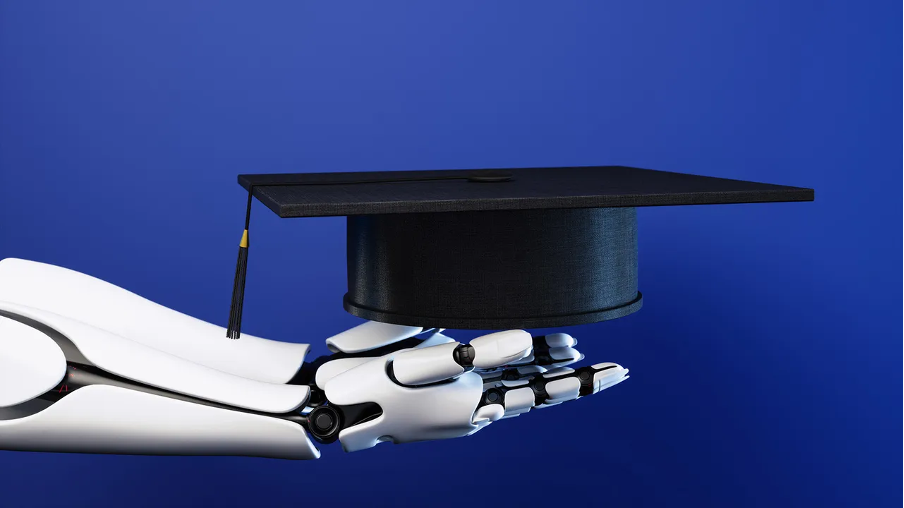
Artificial intelligence (AI) has reshaped the anatomy of the entry-level role and the workforce now rewards graduates who know how to work with AI tools to enhance their own performance.
Universities are also feeling the pressure. For graduates to have a competing chance in the already precarious job market, AI literacy is no longer only expected for students within computer science departments, but more so a foundational skill across any discipline.
AI Literacy as the New Baseline
In the same way students once needed basic computer and Microsoft Word proficiency, today’s graduates need to understand how to integrate AI into their workflows. They’re no longer competing with an AI system for a job (as is the common narrative), but they’re more likely competing with a fellow graduate who understands how to leverage AI tools and software to help augment their process work.
This is the real challenge facing higher education: preparing students to adapt, optimise and innovate alongside intelligent systems, instead of fearing the systems altogether. So, next steps look like ensuring that graduates can strategically orchestrate AI to extend their abilities, and some institutions are already taking decisive action:

In December, Purdue University became
the first U.S. institution to introduce
“AI working competency”
as a graduation requirement.
The Liberal Arts Advantage
Interestingly, this moment marks a renaissance for humanities disciplines. This is because the most valuable skills in an AI-mediated world are cultivated deeply in liberal arts disciplines like philosophy, political theory, linguistics, and the broader social sciences.
“Being successful in the age of AI has more to do with the liberal arts
than with traditional high-tech disciplines.”
- Magnus Egerstedt
| HUMAN SKILLS | TRANSLATED TO AI INTEGRATION SKILLS |
|
1. Critical thinking & systems thinking (Philosophy · Political theory) |
Output evaluation & hallucination detection Training in logical fallacies and argument structure makes graduates adept at identifying when AI outputs are plausible but wrong |
| 2. Ethical reasoning (Ethics · Law · Sociology) |
Responsible AI deployment & bias auditing The ability to identify discriminatory training data, flag harmful outputs, and make decisions about where AI should and shouldn't be used |
| 3. Curiosity & inquiry (History · Anthropology · Literature) |
Prompt engineering & iterative refinement Useful in forming a hypothesis, testing it, reading the result, and refining prompts accordingly |
| 4. Communication & articulation (Linguistics · Language Studies · Communications) |
Precision & AI-assisted writing direction Understanding tone, register, audience, and intent. Also, understanding how social context and multilingual communication add nuance. |
| 5. Empathy & emotional intelligence (Psychology · Social work · Education) |
Human-AI collaboration design & change management Understanding how humans resist change, build trust, and reframe identity under threat is indispensable for successful and ethical adoption. |
| 6. Creativity & narrative (Creative writing · Fine Arts · Drama studies) |
AI-assisted content strategy & creative direction Knowing what story to tell, what voice to adopt, and what to omit is what elevates AI output from slop to human-centered. |
Tim Africa’s Perspective: Preparing for an Augmented Future
At Tim Africa, we don’t view AI as an inherent threat to human talent, but as a multiplier thereof. The future belongs to graduates who can combine their uniquely human insight with strong AI fluency, whether they’re engineers, creatives, policy thinkers or storytellers. As universities move to embed AI literacy across disciplines, the opportunity is clear: a workforce that is not just technologically capable, but imaginative, reflexive and ready for a rapidly evolving world.
Is your curriculum ready for the augmented future? Partner with Tim Africa to bridge the gap between human talent and AI fluency.